
Hair Transplant Surgery

Hair transplant surgeries date back to the 1950s. Surgeons across the world have been working on improving and perfecting these techniques. Of course, the hair transplant surgeries performed today are very different from back then, and the results are also far more superior.
Hair transplant is a surgery performed to treat baldness. The procedure involves removing healthy hair follicles from one area of the body (known as the donor area) and planting them in the area where there is no hair (known as the recipient area). The hair follicles used for the purpose of removal and grafting are called “follicular units”.
The surgeon performing this procedure needs to be highly skilled since the follicular units are fragile and delicate to handle.
There is no ‘one size fits all’ for hair transplant. Dr. Shrirang treats each case on its own merits and suggests a solution that is most appropriate.
Myths about Hair Transplant
- MYTH - Hair Transplant is painful You need to keep in mind that almost all the medical procedures are painful to some extent. However, with new advancements in the field of cosmetic surgery the pain associated with Hair Transplant has diminished significantly.
- MYTH - Everyone can undergo the procedure Remember that not every individual is a good candidate for Hair Transplant surgery. Initially, you require a suitable donor area which has plenty of hair for grafting. Next, you should have a healthy scalp.
- MYTH - Hair transplants can be easily recognized With the new techniques, it really is quite challenging to tell if somebody has undergone the procedure or not.
Who is the ideal candidate for Hair Transplant?
Any adult (male or female) who is suffering from alopecia (baldness) and is medically fit for surgery is eligible for hair transplant surgery.
What to expect before and after the surgery?
Sometimes doctors give medication before the surgery to maintain your current hair growth and keep the donor area healthy. Apart from this, no other medication is administered before the surgery, nor does the patient have to take any extra precautions.
The doctor will prescribe medicines post-surgery to alleviate the pain. You will also need to take some medicines to keep the swelling down and to reduce chances of infection.
After the surgery, Hair Transplant surgeons ask their patients to cover their head for a couple of days after the surgery. The stitches remain absorbable so there is no need for the patient to come to the clinic to remove them. Patients go back to work within a couple of days after the surgery. They are able to resume their daily routine without any major hindrances or precautions.
What are the types of Hair Transplant?
There are two types of Hair Transplant techniques:
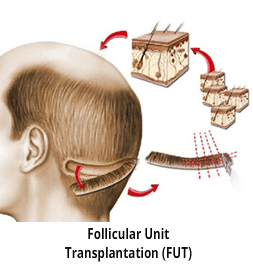
- FUT: In Follicular Unit Transplantation or FUT the doctor selects the donor area near the back of the scalp or the sides of the head. A linear strip is harvested from the center of the permanent zone on the back of the head. The strip is dissected into smaller units known as grafts. These grafts are implanted on the head where there is no hair.
- FUE: Unlike FUT, where a continuous strip is taken from the center of the donor area, FUE involves harvesting individual hair follicles from the entire donor area. FUE shows no visible scarring.
FUE Technique
In FUE hair transplant surgery, Micro Follicular units from donor site are harvested and placed into micro slits made in the recipient area. FUE technique is best suitable for hair transplant which typically need smaller number of grafts (1000-1500 grafts). A Follicular unit contains multiple follicles with different directions.
In FUE, the follicles are harvested with a blind tubular punch, So, chances of a transaction of harvested hair roots (damage to one or more hair root among harvested follicular unit) as well as surrounding follicle is much high with this technique. So less number of hair grow from transplanted follicles than FUT hair transplant Technique. With this technique, maximum we can harvest up to 1500-2000 follicles from a safe-permanent zone.
If we have to get more number of follicles, we need to go outside it. Transplantation with such technique is a very common reason for a loss of transplanted hairs couple of year after the procedure. This is a reason why we don’t recommend FUE technique where more number of grafts is required.
Advantages of FUE technique
It is scarless technique (because scars of microfollicular harvest are not apparently visible), so, beneficial when a person wants very short hairstyle or shaved hairs on back. Also said that FUE hair transplant surgery is a painless technique, but it is not a real advantage of FUE, as you will be given local anesthesia before and pain medicines after a procedure in both FUE & FUT. Considering this, with us, both Techniques are pain-free.
How To Get Computerized Hair Analysis At Pandit Clinic?


FAQs
Get In Touch
Schedule appointments anytime, anywhere! Pandit Clinic offers the convenience of online appointment booking just for you.